Use a review to answer a specific question about a product. Give more weight to concrete observations and a clear match than to a score without context.
Discovery posts, QC photos and in-hand reviews
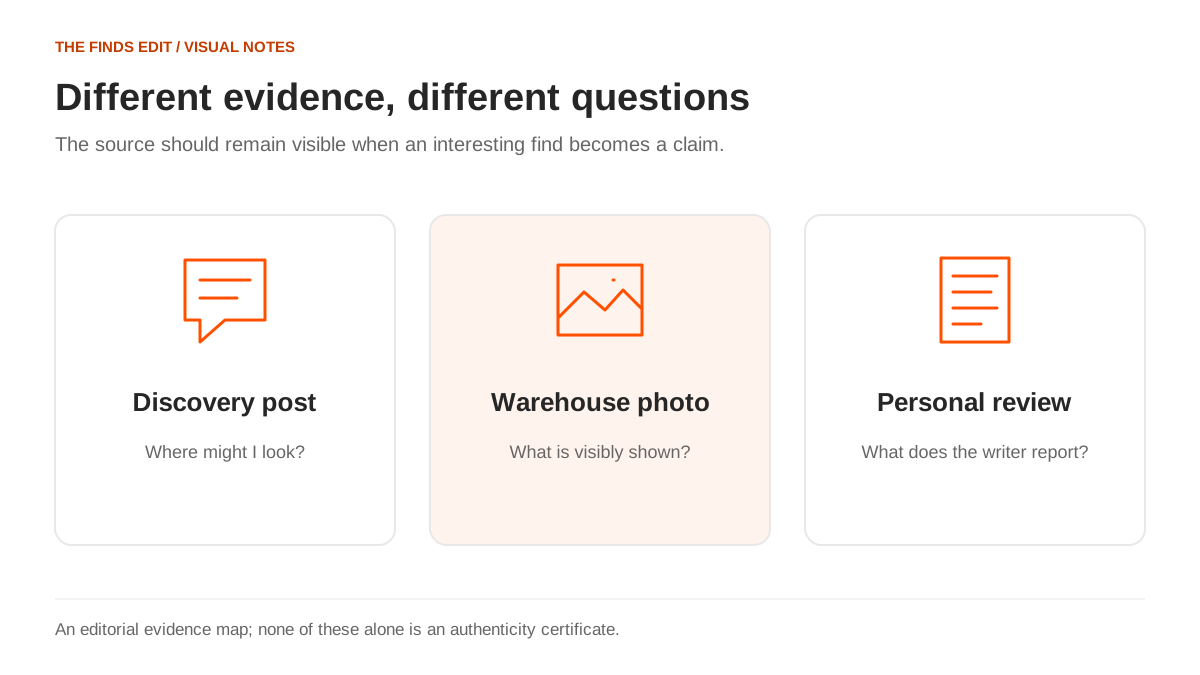
A collection announcement helps you find product links. A warehouse-photo post shows an item at an earlier stage. An in-hand review describes what someone says happened after receiving it. These formats can all contribute to research, but the information you should expect from each is different.
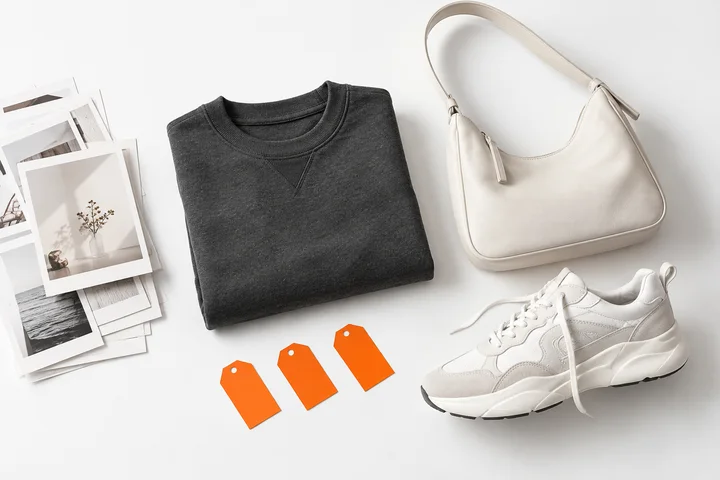
Look for the stage before interpreting the opinion. A photo of a folded sweatshirt may help with the visible graphic and colour, while leaving sleeve length on the wearer unanswered. A wearing photo adds context about proportion. A later report about washing or regular use addresses another set of questions. A high score cannot fill in a stage the post does not cover.
The first useful question is therefore concrete: what am I trying to learn from this post? You might need to know whether a jacket has room for another layer, whether a bag opening fits a book or whether the pictured colour differs across lighting. A focused question makes it easier to separate relevant observations from general enthusiasm.
Product identity and review relevance
Match the item before transferring the experience. Compare the seller reference, model, colour, version and selected size. Similar photographs can describe different offers, and a name shared across several listings does not establish identical construction. A review of an earlier version may be helpful background without answering the question about the option you can order now.
Record any difference you cannot resolve. If a reviewer describes a lined jacket and your destination offers an unlined one, their warmth comments are not directly comparable. If a bundle has changed, their price comparison may concern different contents. Keeping these differences visible is more useful than choosing whichever review sounds most confident.
Use the post’s date alongside the item match. An older review is not automatically irrelevant, particularly for visible design features, but a current listing still needs checking. The review describes an experience at a particular time. The actual offer concerns the version and terms presented when you make the purchase decision.
Fit comments and measurement context
“True to size” means very little without a reference. Look for the purchased size, garment measurements, the reviewer’s preferred fit and any comparison with a familiar garment. Body height and weight can add context, but two people with the same numbers may have different proportions and preferences.
For a hoodie, chest width, body length, shoulder construction and sleeve measurement explain more than a size letter alone. A wide chest with a short body can feel boxy; a similar width with a longer body can create a different silhouette. Compare the relevant measurements with clothing you already wear comfortably, using the same method.
Treat a wearing photograph as an illustration of that person’s fit. Camera angle, posture and the layers underneath affect the appearance. It can suggest a useful question about proportion, but the chart and your reference garment are better tools for deciding whether the same version suits you. This is a comparison method rather than a universal size recommendation.
Interpreting faults and mixed opinions
Specific drawbacks can make a review more useful. A note about a tight cuff tells a different story from “bad quality,” and an observation about a loose thread is different from a fastening that does not work. Look for the location, effect and supporting photo before deciding how important the issue is to your use.
Separate a visible condition from its cause. A buyer can show a mark near a seam without proving whether it came from manufacturing, handling or delivery. Likewise, a garment described as too short may be unsuitable for the reviewer’s preference without contradicting the measurements. Keep the observation and the explanation distinct.
A drawback also needs a practical consequence. Slightly different graphic placement may matter to someone seeking a specific look. Restricted arm movement matters to layering. A zip problem matters to daily access. Your goal is to decide which issue would change your own choice, rather than count positive and negative sentences as though they were equal units.
| Review comment | Missing context | Useful follow-up |
|---|---|---|
| “Runs small” | Size, measurements and preferred fit | Which measurement or movement felt restrictive? |
| “Colour is wrong” | Lighting and the selected colour | Is there a neutral-light photo beside the listing reference? |
| “Great quality” | The feature being praised | Is the comment about fabric feel, stitching, hardware or wear? |
| “Zip is difficult” | Location and effect | Is it misaligned, catching fabric or failing to close? |
| “Shipping was cheap” | Parcel, route, destination and included charges | Does the quoted total describe a comparable shipment? |
Ratings, promotions and comment threads
A numerical rating is most useful when the reviewer explains the criteria. A ten-point score based on appearance cannot answer a durability question. Rather than averaging unrelated scores, collect the observations that concern the feature you need: shape, fastening, capacity or fit after a stated period of use.
Commercial context is worth noticing without treating it as automatic proof of dishonesty. A linked collection, referral benefit or seller relationship can shape the purpose of a post. Reddit’s own spam guidance discusses repeated promotional linking and community-specific rules. It is a reminder to consider the setting, not a method for declaring an individual review genuine or fake.
Read comments for clarification and later updates. A useful reply may identify the selected option or add a measurement missing from the original post. Repeated praise with no extra information adds less. If the author changes their view after use, keep the timeline rather than selecting only the sentence that supports the purchase you already want.
Applying review notes to your own order
Turn useful observations into a small list of checks. If a post raises a question about sleeve length, check that measurement. If it shows uneven hardware placement, inspect the corresponding area in your own order photos. This connects research to an action rather than leaving it as another tab of opinions.
KakoBuy’s official inspection rules cover visible information such as style, quantity, colour, size and model, with exceptions for sealed goods and limits for specialist electronics. Warehouse images can support a visual comparison; they do not reproduce a buyer’s months of wear. Use the right evidence for the question, and ask for clarification while the item is still at the relevant stage.
For example, imagine a clearly labelled hypothetical review saying a hood feels bulky under a close-fitting coat. The useful response is to compare your own coat’s neckline and the hoodie’s construction. It is not a reason to reject every hoodie from the brand. A concrete review becomes valuable when it helps you recognize a specific mismatch.
A compact review note
Keep four fields beside a candidate: exact item match, observation, relevance to your use and unresolved question. An example note is: “Same listed version; reviewer found cuffs restrictive over a watch; relevant to my use; need cuff measurement.” This preserves the useful detail without copying the reviewer’s overall judgement.
If the item match is weak or the evidence does not address your question, mark that limitation and keep looking. You do not need to settle whether a stranger is trustworthy in every respect. You need enough relevant information to decide what to verify, compare or leave out of your own shortlist.
Sources behind this article
Reviewed October 20, 2026. References support the factual explanations in this article. Practical comparisons and examples labelled as illustrative are our own.
- KakoBuy inspection rules ↗
Official limits of visual inspection; checked in the rendered help centre.
- Reddit Help: Spam and promotional participation ↗
Official guidance on repeated promotional linking and community-specific rules. Used as context for reading promotional material, not to judge individual reviewers.