Look for distinct options, clear product information and a manageable comparison process. A record count alone tells you very little about those qualities.
Search goals and directory size
The most useful product collection depends on what you need to find. Someone searching for an exact sneaker colourway has a different task from someone choosing a first everyday jacket. An extensive index may offer more possible matches for the first task. A smaller set of clearly different jackets may be easier to assess for the second.
Start by writing down the task in one sentence. “Find an alternative to this exact model” calls for breadth within a model family. “Find a jacket that works over my hoodie” calls for differences in length, layering room and fastening. These are practical search goals, and they give you a reason to reject distracting results.
Directory size is still useful information, but only when you know what is being counted. Separate product records, colour variants and repeated seller references can all add rows. A headline total does not tell you how many different choices appear on a particular category page. Examine a sample of the actual cards before deciding that a large number means a broad selection.
Useful variety across shape, purpose and price
Variety has several dimensions. Two hoodies may differ by print while sharing the same cut. Two plain jackets may look similar at thumbnail size while differing in length, lining and intended layer. The second difference can matter more to the person building an outfit, even if the first makes a busier grid.
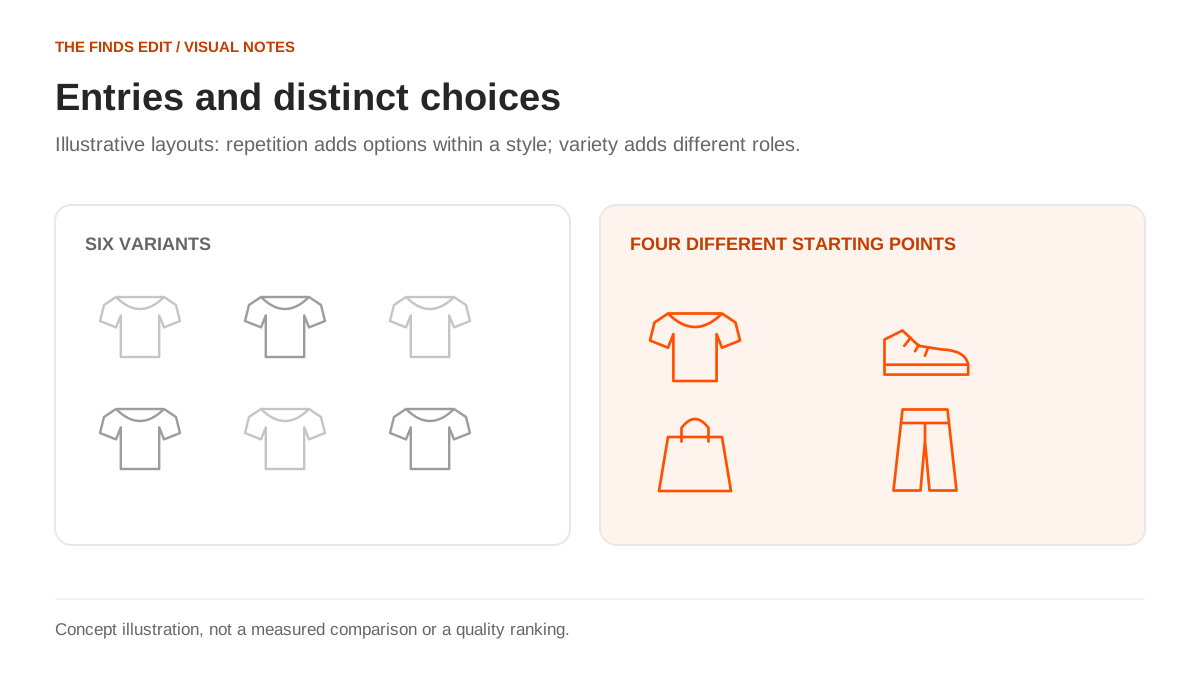
A varied edit should make those differences visible. Compare product roles first, then the details within a role. For an everyday outfit, a crewneck, zip hoodie and overshirt provide different neckline and layering possibilities. Once you have chosen the role, comparing several colours of the preferred cut becomes more useful.
Price variety also needs context. A lower-priced single garment and a higher-priced set should not be treated as directly equivalent offers. Look for a range of alternatives that answer the same need with clearly stated inclusions. More brands can broaden discovery, but changing the logo without changing the product’s role is only one kind of variety.
Product information and photo consistency
Clear product information lets you follow the same item from card to listing. Check that the pictured style agrees with the brand and model label, and that the destination shows the intended offer. A photograph of a two-piece set beside a price for one component needs explanation before it can support a fair comparison.
Physical context in photographs can help you see the garment or shoe more clearly. A hand, rail or floor texture can provide visual clues, although perspective still makes exact size estimates unreliable. Added advertising and unrelated collages can obscure what belongs to the product. A clean photograph is easier to inspect when it retains the details you actually need.
Then look for the information that an image cannot supply: measurements, selected variant, stated composition and what is included. The useful directory makes these easy to locate or identifies the question still to ask. A polished grid with no way to distinguish its variants can leave more work than a simpler collection with precise records.
A comparison framework for two directories
Use the same search task in both places. Open a small sample and compare the information needed to make the next decision. You do not need a universal score or a complicated ranking formula. Record the strengths and gaps that matter to your own search.
| Area | What to examine | Useful result |
|---|---|---|
| Product variety | Repeated colours versus different shapes and roles | Alternatives that resolve different needs |
| Identification | Agreement between photograph, label and listing | A clearly traceable item |
| Price information | Currency basis, ranges and inclusions | Comparable item estimates |
| Fit information | Measurements and the selected version | A specific question you can answer |
| Maintenance | Meaning of the update date and state of sampled links | An honest account of what was checked |
| Browsing effort | Search, category relevance and saved candidates | A shortlist you can revisit without starting again |
A weak result in one row does not mean every item is unusable. It tells you where additional work is needed. For example, a model-focused index may be excellent for finding a rare colour but offer little help with fit. You can use it for discovery while recognizing that measurements must come from elsewhere.
A worked edit for a three-layer outfit
Imagine an illustrative search for a light outfit built around trousers and shoes you already own. The first collection offers six black graphic hoodies. The second offers a plain crewneck, zip hoodie, overshirt and short jacket. Neither sample proves overall product quality, but the second gives you more ways to change the outfit’s structure.
Choose a role before choosing a winner. If you need a removable outer layer for an indoor-heavy day, the overshirt and jacket deserve closer comparison. If you want a visible hood under an existing coat, the zip hoodie may be the relevant candidate. The other options can leave the active shortlist without being judged bad products.
Next, compare two candidates for that same role using length, chest room, sleeve shape, fastening and current selected-option price. Keep one alternative only if it offers a useful difference. This creates a smaller list through a reasoned process, rather than deleting items until an arbitrary target is reached.
How our catalog is selected
Our categories contain 24 reviewed styles each, arranged to mix brands and product types. The homepage has a separate 24-item clothing edit focused on seasonal graphics, festive colour and autumn/winter layers. It is not a fixed sample of three products from every category, and its order is an editorial choice rather than a sales ranking.
The review compares listing text, visible branding, category and photographs. Obvious repetitions are grouped using style and image references. This helps reduce repeated entries, but it is not a physical inspection of the products. Two records with similar names can still require separate attention to versions and inclusions.
That is why catalog selection and product evaluation remain distinct. Selection makes the browsing sample more coherent. Your actual purchase decision still depends on the exact listing, fit information, budget and use case. The value of the edit is easier comparison, not a promise that every retained item will suit every reader.
Shortlist notes and stopping points
Give each saved candidate three short notes: its purpose, its difference from the next option and the information still missing. “Longer hem; fits over my sweatshirt; need sleeve width” is enough to restart the comparison later. Saving only the brand and price often leads you back through the same research.
Keep alternatives while a real decision remains open. If two products serve the same purpose and one has the measurements and details you need while the other remains ambiguous, that is a reason to concentrate attention. If both are unsuitable, keep searching rather than treating the shortlist as a commitment to buy.
A useful stopping point is being able to explain why the chosen candidate answers the task, how it compares with the nearest alternative and what the total order still requires. A good directory supports that explanation. Its size is secondary to whether its information helps you reach it.